Thursday, December 24, 2015

Jesus of Christmas


One of my favorite church conflicts involved the placement of baby Jesus in the manger of the congregation’s outdoor nativity scene. A previous pastor had demanded Jesus not be placed in the manger until Christmas eve. Members of the church felt an empty manger was an embarrassment because all the other churches put their baby Jesus in the manger right away. Sides were taken, bad words spoken and hard feelings were forged.

When invited into the debate I provided a less than inspiring response. I could care less. A look of horror came over the member’s face who asked for my opinion. She couldn’t believe I was not taking it seriously. I explained, “This is not Jesus. This is a plastic figurine with a lightbulb up his backside. There are a million serious things to fight about. Little plastic illuminated baby Jesus is not one of them."

These kind of arguments always leave me wondering, how do any of our traditions help us understand Christmas?  Events this past month have given me pause to think about how we understand the Jesus of Christmas. Strangely, nothing speaks more directly to this than our culture trying to relate Allah to Christ.

At times like these, I find myself drawn to the lessons I learned from Winston Persaud, one of my favorite professors at Wartburg Theological Seminary. Winston had this amazing ability to take complicated thoughts and weave them into a simple sentence. Sentences I could easily grasp and remember.  About Jesus, Winston would always say, “We don’t look behind Jesus to see God.”

Too often we think of Jesus in biological terms. Jesus is to God what my son is to me. Jesus is not the offspring of a God who stands behind him. He is the image of the invisible God who called out to Abraham. Jesus is the visible image of the God who was revealed in a fire to Moses. When we look at baby Jesus in the manger, we are looking at the God of Abraham.

Worried that I had failed to teach my children appropriately, I questioned my son on the way home from college. I asked Peter, “Who do the Jews worship?” He responded, “the God of Abraham. We continued, "Who do the Muslims worship? The God of Abraham. Who do we worship? The God of Abraham.” I sighed in relief.

Winston would also say, “God speaks in a multitude of languages, but has spoken something specific in Christ Jesus.” If God is an elusive invisible presence, we can shape our understanding of God to our comfort level. It is the moment we accept a specific statement made about this God that we lose our control. This is the difficulty of Christianity.

Our break with Judaism and Islam is not that we worship a different God, but the specific claim we accept about the same God. A claim for which there is no human proof, only an experience passed on from one generation to the next through worship, teaching, rituals and traditions. An experience grounded in the witness and testimony of those who experienced it. The truth of this experience was not the result of human minds working together.  It was a truth proclaimed by the one who created it.  We simply accept it.

Over the past 2,000 years the question remains the same.  Is the child born in Bethlehem a skilled teacher, a great prophet or, as Paul writes in Colossians, “the image of the invisible God?”

Too often what stands in our way of grasping the specific answer to this question are the arguments we humans create. If we can argue over when to put plastic Jesus in a manger scene then we are capable of creating a wide variety of arguments that cloud our ability to see God. Human agreement does not define who God is and what God does. The absurd proclamation that this child is God invites us to realize God works in ways that defy our understanding. And that’s a good thing.

The other night, Peggy and I realized how much we miss seeing the stars. The ground lights of the city and trees prevent us from seeing them. Cut off from the stars all we look at are the works and accomplishments of human hands. Without realizing it, all of us who cannot see the stars or do not take time to ponder them, lose a sense of the almighty. We become defined by the finite reality of human life.   Things are only real if humans can make them.

This Christmas eve I invite to look deep into the night sky, if you can.  Consider the stars and the universe that holds them together.   Stars speak to things not created with human hands. They speak of wonder, awe and mystery.  They testify to a God who can do things beyond our understanding. 

Then contemplate the specific truth we proclaim when we celebrate the Jesus of Christmas.    See, in this child, the home of God is among mortals.  God will dwell with us and we will be God's people, and God with be with us. (Rev. 21: 3ff)  God dwells with all of creation, but it is those who cling deeply to it that find the greatest expression of hope in a wounded world.  May the Hope and Peace of Jesus guide your hearts and minds this night and all nights throughout the coming years. 


Wednesday, November 5, 2014

The Hope of Change


“The heavens declare the glory of God; the skies proclaim the work of his hands” 
Psalm 19:1

Peggy and I took a couple of days to enjoy the fall colors and to spend some quiet time alone in the north woods. I found myself getting lost in a book I was reading.  The author made a statement that caught my attention, “as we all know, God never changes.”  What struck me was how much I don’t believe it.  

God never changes?  If the psalmist is right, “the skies proclaim the work of his hands,” then creation tells a totally different story.

Outside our cabin leaves were changing color before our very eyes.  I looked out over a lake and a landscape radically changed by glaciers.  Beyond the veil of grey clouds hovering over us, a universe was spinning in a constant state of change.  Forget the big picture stuff, all I had to do was look in the mirror.  I am changing, getting older every day.  

At St. Luke, Amanda and I have been teaching about the different ways God has pursued us.  How God has spoken to us through prophets, priests and kings.  Change was at the core of God coming to dwell among us.  And, just when people were beginning to understand him, Jesus was gone, ascended into heaven.  

Yes, God’s purpose does not change.  Yes, God’s power and authority does not change.  But saying God never changes feels more like our yearning to make God like us.  We don’t want to change, so we don’t want God to change as well.

I was taught that history is doomed to repeat itself.  When I was younger I thought this a profound and sad truth.  In my older age, I’ve begun to realize it is no more profound than calling the sky blue.  History repeats itself because we are unchanging. 

Change is an unrelenting force that confronts us against our will.  It stresses us out and leaves us fearing the unknown future that follows it.  While I ache for all who struggle to cope with change, my heart is grounded in it.  Our most profound encounters with God come when we invite God to change us. 

I think change is the ultimate expression of God’s power.  Our hope and salvation comes from God changing his mind on what we deserve.  God invites us to be born again, to change our hearts, to allow God to create something new within us.  


Isn’t it funny how we struggle to deal with personal change, yet discover a sense of awe in the changing color of leaves each fall.  Heaven and earth declare the glory of God.  The glory is found when the old us dies away and new life emerges.  It is the change that produces hope.  I hope and pray you can open your heart to change, to discover something new in Christ.

Friday, April 11, 2014

The Freedom of Silence


One evening as I drove home from work, I saw the setting sun blazing bright orange through the tall pines.  It looked like a fire burning deep within the woods.  My heart was restless that evening. A silent void had found its way into my soul and it needed some healing.  Memories of Pastor Bob quoting Elizabeth Barrett Browning came rushing to my thoughts,

Earth’s crammed with heaven,
And every common bush afire with God;
But only he who sees, takes off his shoes,
The rest sit round it and pluck blackberries

Had it not been so cold, I would have taken off my shoes and pursued the flame.  It just felt like it had the potential to be a burning bush experience. 

Every evening since, I look for that fire burning.  Hoping that I might actually find a special encounter with God in the woods of Newport, MN.  I don’t need the miracle as much as I need to hear the voice of God say, I have seen the misery of my people…” (Ex. 3:7)  I do hear those words when I read scripture, sing hymns and pray.  But just once I would like to hear God speak them directly to me.  It might help them stick deeper into my soul. 

God came to Moses because God saw the misery of Israel.  It was a misery forced on them by Pharaoh.  The misery I see around me and seek relief from is different.  It is the inescapable misery of a bondage freely placed on ourselves.  A bondage where silence causes panic.  Sabbath rest leads to feelings of worthlessness and time on the internet produces a sense emptiness.  

Technology cultivates a loneliness that often goes unperceived. Computers allow us the ability to feel productive when in truth we are often just filling time with idle activity.  It helps us escape an in-depth look into our souls.  We are afraid of finding that silent void deep within us because we’re not convinced there is a cure. Staying “busy” avoids the issue altogether.

Lord, you see the misery of your people, but can you save us from ourselves?    

My heart yearns for koinonia.  The Koinonia Community of my youth.  The place where every day ended in the meditative silence of a Taize prayer service.  I miss the stillness, reflection and peace of a disciplined community prayer life.  Koinonia is also a Greek word meaning a special communion or community with God.  My heart yearns for that koinonia as well.  

Silence makes it impossible to quiet the thoughts and struggles that torments our souls. Silence in worship makes it impossible to keep Christ out of those areas we don’t want him to go.  But silence in worship with others, reminds us we are not alone.  Together we discover a burning bush - that God still speaks, I have seen the misery of my people and Christ still meets us with freedom.

The problem is silence still makes most us feel uncomfortable both in and outside of a sanctuary.  I pray we can discover a way to embrace a spiritual experience we do not want, but need.  The freedom of it feels so good.


Tuesday, January 28, 2014

What Do You See?


The Lord does not look at the things people look at. People look at the outward appearance, but the Lord looks at the heart. 1 Sam. 16:7

A couple of Sundays ago I preached a sermon I really enjoyed.  Not sure how people received it, but I enjoyed giving it.  In the sermon I suggested quantum mechanics and string theory might provide an image of God. I wasn’t trying to prove God or disprove science. I was merely suggesting, that God, at least the activity of God we confess, is mathematically possible.  

Researching the sermon I came across a quote from Robert Anton Wilson, “We are looking at reality from the view point of our own reality.”  I found this quote to be very revealing of our culture in many ways. Specifically, how it views the church.  People will see what they want to see.

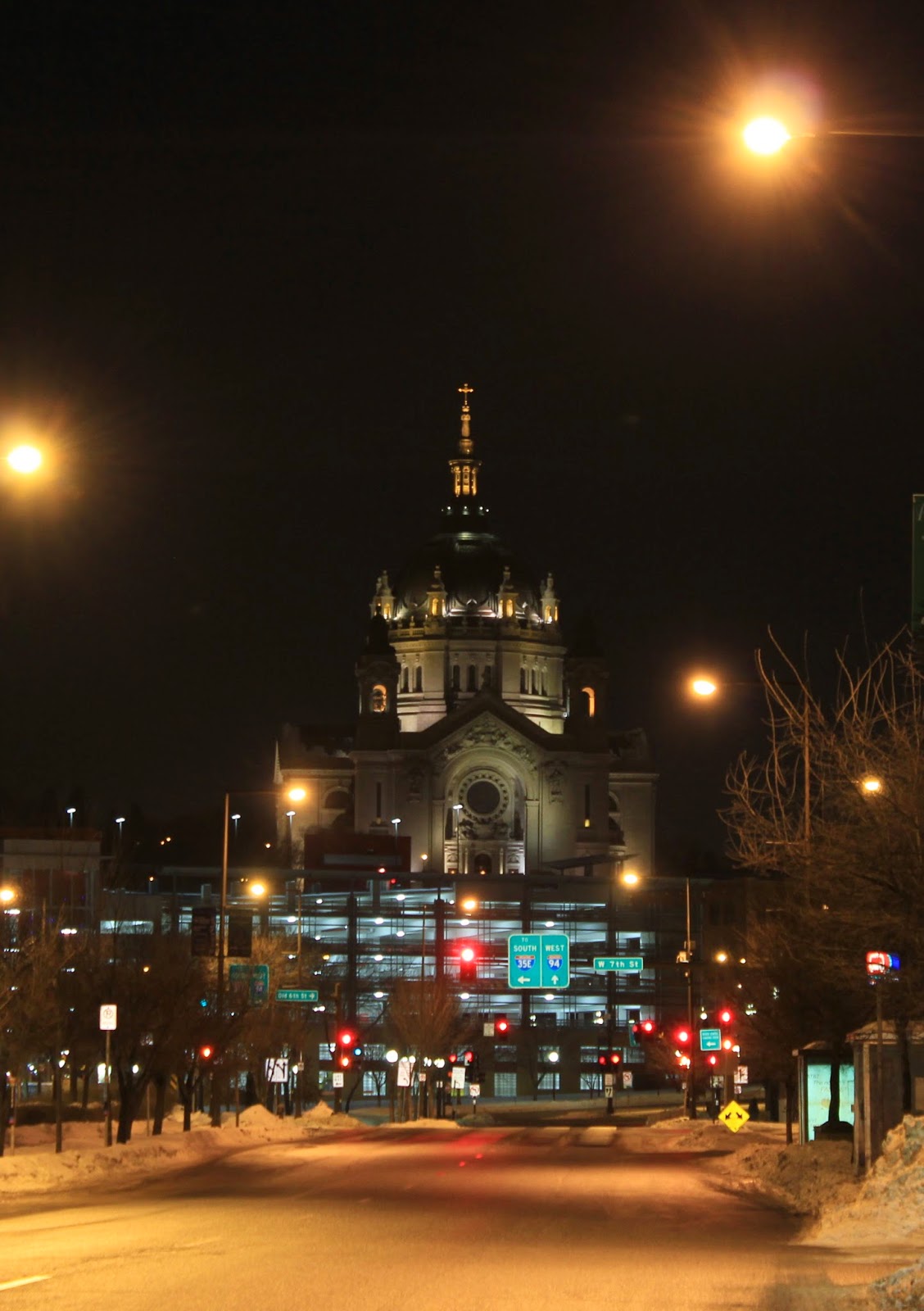
Look at this picture of the Cathedral of St. Paul. What do you see? Those who do not like the church may see money wasted on a grand building while the poor suffer.  They might see clergy abuse, hypocrisy, and oppression.  A person who does not like the Christian faith or Catholicism, most likely will see a hundred things in this image to support their hatred or dislike.

I’m fascinated by what you cannot see.  I am standing on 7th Ave on an extremely cold night.  On the right side of this picture, just past the bus stop, is the Catholic Charities Center of St. Paul and Minneapolis.  It’s in a very nondescript building.  A building as plain as the Cathedral is grand.

I have driven down this road many nights since moving to St. Paul.  It typically is full of poorer people walking the street.  But not this night, this night they have found shelter in the church.   When we choose to see the church’s faults, of which there are many, we lose our ability to see its blessings.  Serving those at risk and in need has always been the fabric of our mission in Christ - Catholic or Protestant.

Robert Anton Wilson was a free thinker who loved discord and hated the church.  He was born in a Methodist hospital because it provided his mother affordable healthcare.  He received a free education at a Catholic school.  But he chose not to see that aspect of the church.

The Cathedral of St. Paul stands on the boundary between extreme wealth and extreme poverty.  It serves both sides of that boundary in different ways.  If it fails to minister to either side of that boundary, it fails in its mission.  The structure dominates the St. Paul landscape.  It faces the Minnesota State Capitol reminding me that the Church needs to be engaged in politics as well as sermon preparation.  Most of all, it never escapes my view.  The building reminds me that God is firmly planted in all things and in all people.  God is working through me and the atheist, through the wealthy and the poor, through every living creature and thing.  

What or who do you see at work in your life?  And, how does it shape your heart?

Monday, December 16, 2013

Isaiah 11


I had planned on taking my sermon from the early service and shortening it for the Children’s Christmas program.  It wasn’t until the program started that I realized my central image - a rat colony turning on itself - was not going to work.  So as the children began to sing, I desperately searched for a new image.  

I got lost in thought and missed my cue to come forward.  So, the only child not to enter on time in this year’s Christmas program was the senior pastor.  However, the time did allow me to find a new direction.  As I drifted to the back of the room, it hit me, the Holy Spirit had opened my eyes to see something much deeper.  

It is hard not to look on those children in a Christmas program without an overwhelming sense of hope.  Parents believe their children can become anything in the world - a pro athlete, an actor, a singer, etc...  Most likely, though, their childhood hopes will not match their adult reality.  But are childhood hopes really the enduring hope that will sustain us through our adult life?  I don’t think so.

What if we lived our adult life with the same level of hope we project onto our young children?  What would this kind of life look like?  In all my years of ministry I have learned two universal truths.  The easiest part of ministry is convincing a child they can do something they never dreamed possible.  The hardest aspect is convincing an adult of the same thing.

Adult hope is hard.  We’ve tested the world and have the scars to prove it.  Adult hope cannot be found in what we dream to become when we grow up.  It is what we remain when life has cut us down - a child of God.  Isaiah reminds us the shoot that emerges from the stump of Jesse is hope.  An enduring hope for all us, regardless of age.

Watching the children twist and turn on stage also got me to thinking.  We will enjoy every mistake these kids make on this day.  The little girl chewing on her beautiful new dress is adorable.  The little boy shouting louder than anyone else makes us smile. When it is all over we’ll smile, laugh and hug our children.

What if we parented our adult children with the same level of grace we extend to our little children in a Christmas program?  The mere thought of this idea makes most parents bristle.  It reveals a deeper truth about our living a Christian life.  We have a romanticized idea of what grace could mean, but little trust that grace could be a workable adult reality.


Isaiah reminds us that God will not judge as the world judges (11:3).  God judges with grace and mercy.  The older I get the more I discover how much these words are shape my present life.  I am learning to parent in grace.  It has brought me such peace.  This Christmas season, I pray you discover the power of living in hope and grace and the peace it brings.

Sunday, November 24, 2013

Overcome Evil


Do not be overcome by evil, but overcome evil with good. romans 12:21 

I thought about using a “selfie” as the picture for this blog, but it made me too uncomfortable. A straight on selfie makes my face look bloated.  A picture taken from the top looking down highlights my thinning hair.  The opposite angle, bottom looking up, shows the fat under my chin.  Plus, I’ve learned from experience, I look better the farther I am from the camera.

Instead, I decided to post pictures of my wife and my daughter - two of the most beautiful people in my life. (The only reason Peter is not included, I couldn’t find a picture of him to fit with these two images.) Their smiles radiate joy. When I look at these pictures it brings me an overwhelming sense of calm.  I feel blessed to have such beautiful people in my life.

They would never give me permission to post these pictures.  So I did it without their knowledge.   If I had asked for permission they would only have tried to convince me these images show their flaws.  They would go into great detail about flaws so small the average eye cannot perceive them.  I cannot see the flaws through the radiance of their smiles.

Eventually, they would bring me down.  I could never be convinced they were anything less than beautiful.  But I would be depressed by their inability to see their own beauty and the joy it brings me.  

You may be thinking to yourself, how is this different from the reasons I gave for not posting a “selfie”?  Welcome to the pool of hypocrisy I force my family to swim in.  There is no difference, it is just easier to see it in them than myself.

We all have difficultly seeing our own beauty and no problem identifying our long list of flaws. To me, there is something inherently evil about this trait.  Not only does it defy the will of God who declared our creation very good (Gen. 1:31).  It makes us vulnerable to those who try to control us by manipulating our weaknesses.  

Our own words carry no weight when we try to convince ourselves we are beautiful. We need the words of others to remind us God was right, we are very good and beautiful.  Good words to others do more than stroke egos. They proclaim the greatness of God.  It makes me think of the old hymn, All Things Bright and Beautiful.

All things bright and beautiful,
All creatures great and small,
All things wise and wonderful:
The Lord God made them all.

He gave us eyes to see them,
And lips that we might tell,
How great is God Almighty,
Who has made all things well.


Each day we are presented with the option to either be overcome by evil, or overcome evil with good.  Will we allow weaknesses to be magnified or beauty to be proclaimed?  More often than not, the words we share with others dictate this for us.  This Thanksgiving overcome evil with good by telling someone that you are thankful for their beauty.

Friday, November 1, 2013

While I Kept Silence


While I kept silence, my body wasted away... For day and night your hand was heavy on me... Then I acknowledged my sin to you, and did not hide my iniquity...and you forgave the guilt of my sin...You are a hiding place for me...you surround me with glad cries of deliverance.
Psalm 32: 3 - 7

It defies reason that a person would keep silent when in desperate need.  Especially in life or death situations. Yet, I remember a particular accident where a student drowned in the middle of a swimming class.  Friends swam nearby.  An instructor stood on watch.  There was no indication of neglect.  Still, the student drowned and no one saw it.  

Shortly after the accident, I spoke with a YMCA executive who had years of experience teaching swimming.  He said, “Most people don’t understand, drowning is a silent event.”  We tend to think of the movie version of drownings.  On the big screen, people scream and flail their arms.  When, in fact, fear paralyzes the swimmer and they just disappear without a sound into the water.  It is a scary thought, especially for lifeguards.

It is hard for us to think that someone would not ask us for help.  It hurts us deeply when a person close to us remains silent.  But, how often, when burdened with a problem, do we ourselves actually call out for help?  We don’t want to be seen as weak, vulnerable or a failure.  So we remain in our silence and allow our bodies to waste away as the psalmist says in Psalm 32.

Emotional burdens are some of the most oppressive baggage to carry around.  They not only effect our minds, they literally can destroy our bodies.  The mind and body then work over the soul leaving us paralyzed.  Still, too often, we would rather drown in the baggage of our failures then call out for help.  

As I was reading this psalm, it reminded me that my wife had asked me to talk to someone last year.  She was concerned that the burdens I was carrying around were harming me.  At first, I wasn’t sure who I wanted to help me.  Then pushing aside the problem became a comfortable way of life.  Yet, while I kept silence my body, mind and spirit were wasting away.

Ultimately, I discovered the one I most needed to talk to was God.  All other voices came off as Job’s friends trying to rationalize a predicament.  So I poured out all of my silent thoughts in prayer.  I opened my heart for God to see what was inside. Silly exercise, since God was looking into my heart all along.  But looking in is not the same as being invited in.  

All of these thoughts were with me as I walked down a quiet trail in northern Wisconsin this week.  The leaves had fallen from the trees. The few that remained were dead, brittle and barely holding on.  The barren trees exposed the intimate details of the forest.  It hit me, once again, even the forest understands that the old life needs to die for new life to take hold.  

The psalmist is speaking to me.  Freedom comes from calling out and laying bear our inner soul.  It is a dangerous activity.  We don’t like revealing our inner self.  But in our weakness, God gives us strength.  My iniquities, your iniquities, do not bring judgement, but forgiveness and new life.  No wonder the psalmist hears glad cries of deliverance.  I know I did.